 IG
IG FOREX.com
 CMC Markets
 XTB
XTB eToro
eToro AvaTrade
 Pepperstone
 FP Markets
 Tickmill
Tickmill Review

Written by Steven Hatzakis
Director of Online Broker Research

Edited by Jeff Anberg
Senior Editor

Fact-checked by Blain Reinkensmeyer
Managing Partner
Steven HatzakisDirector of Online Broker Research
Steven Hatzakis is the Global Director of Online Broker Research for ForexBrokers.com. He is a forex industry expert and an active fintech and crypto researcher.


CFDs are complex instruments and come with a high risk of losing money rapidly due to leverage. 73% of retail investor accounts lose money when trading CFDs with this provider. You should consider whether you understand how CFDs work and whether you can afford to take the high risk of losing your money.
I've spent more than two decades trading forex and reviewing brokers, and the past few months I've put considerable time into testing Tickmill across its proprietary Tickmill Trader web and mobile apps, the full MetaTrader suite, and TradingView. I measured EUR/USD spreads on both account types, worked through the order ticket, and benchmarked the lineup against other competitors I reviewed this year.
In my view, Tickmill is best suited for cost-conscious forex and CFD traders, particularly those running algorithmic strategies. Pricing on its commission-based Raw account is among the more competitive I tested this cycle, and the MetaTrader suite gives algo traders the tooling they expect. Where it falls short is its range of assets. The 62-pair forex lineup and 637 tradeable symbols trail the multi-asset leaders, and its research tools feel scattered rather than cohesive.
Overall, active and algo-focused traders will find Tickmill well-equipped. If you want access to wide multi-asset markets or deeper research, I'd spend time looking into larger global brokers like Saxo or IG.
-
Minimum Deposit:
$100 -
Trust Score:
85 -
Tradeable Symbols (Total):
637
| Range of Investments | |
| Trading Fees | |
| Trading Platforms | |
| Research | |
| Mobile Trading | |
| Education |
Check out ForexBrokers.com's picks for the best forex brokers in 2026.
| 2026 | #23 |
| 2025 | #22 |
| 2024 | #23 |
| 2023 | #24 |
| 2022 | #21 |
| 2021 | #18 |
| 2020 | #24 |
| 2018 | #29 |
 Why you can trust us
Led by Steven Hatzakis, Global Director of Online Broker Research, the ForexBrokers.com research team collects and audits data across more than 100 variables. We analyze key tools and features important to forex and CFD traders and collect data on commissions, spreads, and fees across the industry to help you find the best broker for your needs.
We also review each broker’s regulatory status; this research helps us determine whether you should trust the broker to keep your money safe. As part of this effort, we track 100+ international regulatory agencies to power our proprietary Trust Score rating system.
Our researchers open personal brokerage accounts and test all available platforms on desktop, web, and mobile for each broker reviewed on ForexBrokers.com. Learn more about how we test.
Can I open an account with this broker?
Use our country selector tool to view available brokers in your country.
Table of Contents
Tickmill pros and cons
Pros
- Commission-based Raw account delivers competitive all-in pricing.
- Full MetaTrader 4 and 5 suite, plus FX Blue add-ons and VPS hosting.
- Well suited to algo trading, with copy trading via Tickmill Social.
Cons
- Modest range of investments: 62 forex pairs and 637 tradeable symbols.
- Tickmill Trader lacks trailing stops, price alerts, and algo support.
- Research content has thinned, with podcasts and livestreams paused.
My top takeaways for Tickmill in 2026:
- The commission-free Classic account averaged 1.7 pips on EUR/USD, while the commission-based Raw account pairs low spreads with a $3-per-side commission ($6 per round turn).
- A focused lineup of 62 forex pairs and 637 tradeable symbols, built around the most popular forex and CFD markets.
- 97 charting indicators in the Tickmill Trader platform, powered by TradingView, alongside the full MetaTrader 4 and 5 suite.
- 15 crypto CFDs, a small but growing lineup that is not available to U.K. retail clients.
- Three CPD-accredited trading courses with the London Stock Exchange and Knightsbridge Trading Academy, totaling 28 hours and free with an active live account.
Trust Score
Developed by ForexBrokers.com and in use for nearly 10 years, Trust Score is a proprietary rating system powered by a range of unique quantitative and qualitative metrics, including each company’s number of regulatory licenses. Trust Scores range from 1 to 99 (the higher a broker’s rating, the better). Learn more.
Is Tickmill safe?

Tickmill is considered Trusted, with an overall Trust Score of 85 out of 99. Tickmill is not publicly traded and does not operate a bank, but is authorised by two Tier-1 regulators (Highly Trusted), two Tier-2 regulators (Trusted), zero Tier-3 regulator (Average Risk), and one Tier-4 regulators (High Risk). Tickmill is authorised by the following Tier-1 regulators: Financial Conduct Authority (FCA), the Cyprus Securities and Exchange Commission (CySEC), and regulated in the European Union via the MiFID passporting system. Platform, product, and leverage availability vary by entity, so it is worth confirming where each Tickmill entity is regulated before opening an account.
| Feature |
 Tickmill Tickmill
|
|---|---|
| Year Founded | 2014 |
| Publicly Traded (Listed) | No |
| Bank | No |
| Tier-1 Licenses | 2 |
| Tier-2 Licenses | 2 |
| Tier-3 Licenses | 0 |
| Tier-4 Licenses | 1 |
Range of investments
Across Tickmill's account offerings, I counted 62 forex pairs and 637 tradeable symbols in total, covering the major and minor currency pairs, index CFDs on benchmarks like the S&P 500 and DAX, commodity CFDs spanning gold, oil, silver, and agriculturals, and a set of thematic index CFDs. It is a practical range for a forex-first trader, but it trails the largest multi-asset brokers I review, several of which list well over 100 currency pairs alone.
Stocks and ETFs: Traditional stock and ETF investing is not part of the offering at Tickmill. You can trade U.S. share CFDs, with roughly 500 stock CFDs available on MetaTrader 5, but there is no physical share ownership and no ETF CFDs. For traders who want to hold equities directly, this is a real gap.
Cryptocurrency: There are 15 crypto CFDs, a small but growing lineup that mixes established coins with a few meme tokens. Crypto is offered as a CFD only, never as the underlying asset, and crypto CFDs are not available to retail traders from any broker's U.K. entity due to regulation.
Futures and options: Exchange-traded futures and options are available, but only through Tickmill's U.K. entity and its CQG and Agena Trader platforms, which provide access to CME Group products. If you are outside the U.K., this part of the catalog will not be available to you.
Leverage: Maximum leverage depends on your country of residence, the Tickmill entity that holds your account, and whether you are classified as a retail or professional trader. At the extreme, on its Seychelles entity, it can reach 1000:1 for certain forex pairs, which I would not recommend under any circumstances, since losses can mount quickly at that level.
Available investment products
During our audit, we verified access to 62 forex pairs alongside CFDs covering indices, commodities, equities, and a 15-coin crypto lineup, for 637 tradeable symbols in total.
| Feature |
Tickmill
|
|---|---|
| Tradeable Symbols (Total) | 637 |
| Forex Pairs (Total) | 62 |
| Forex trading (Spot) | Yes |
| Forex trading (CFDs) | Yes |
| Forex trading (Options) | No |
| Forex trading (Futures) | No |
| Forex trading (Crypto) | No |
| Commodities: Agriculturals | Yes |
| Commodities: Oil | Yes |
| Commodities: Gold | Yes |
| Commodities: Silver | Yes |
| U.S. Stocks (Shares) | No |
| U.S. Stocks (CFDs) | Yes |
| U.S. Stocks (Crypto) | No |
| Global Stocks (Non-U.S. Shares) | No |
| Global Stocks (Non-U.S. CFDs) | No |
| 24/5 Trading (U.S. Stocks - Shares) | No |
| 24/5 Trading (U.S. Stocks - CFDs) | No |
| 24/7 Trading (Crypto) | Yes |
| Prediction markets | No |
| Copy Trading | Yes |
| Bitcoin (BTC) | Yes |
| Ethereum (ETH) | Yes |
| Cryptocurrencies (Total) | 15 |
| Cryptocurrency (Underlying) | No |
| Cryptocurrency (CFDs) | Yes |
| Cryptocurrency (Futures) | No |
| Disclaimers | Note: Crypto CFDs are not available to retail traders from any broker's U.K. entity, nor to U.K. residents (except to Professional clients). |
Available funding options
Our tests confirmed support for bank wire, debit and credit cards, PayPal, Skrill, Neteller, and cryptocurrency transfers. Apple Pay and Google Pay are not currently offered.
| Feature |
Tickmill
|
|---|---|
| Debit card (Deposit/withdraw) | Yes |
| Credit card (Deposit/withdraw) | Yes |
| Bank Wire (Deposit/Withdraw) | Yes |
| Non-wire bank transfer | No |
| Apple Pay (Deposit/Withdraw) | No |
| Google Pay (Deposit/Withdraw) | No |
| Crypto (Deposit/withdraw) | Yes |
| Cryptocurrency (Wallet transfers) | No |
| PayPal (Deposit/Withdraw) | Yes |
| Skrill (Deposit/Withdraw) | Yes |
| Neteller (Deposit/Withdraw) | Yes |
Tickmill fees
Tickmill competes hard on price, and for cost-focused traders that is the main reason to put it on a shortlist. The structure is refreshingly simple: two retail accounts, the Classic and the Raw, each with a low $100 minimum deposit. The difference between them is entirely about how you pay to trade.
The Classic account is spread-only. It charges no commission, so your whole cost sits in the spread, which averaged 1.7 pips on EUR/USD during testing, higher than the tightest pricing I see elsewhere. The Raw account flips the model: spreads track far closer to the underlying market, and you pay a transparent $3 per side, or $6 per round turn, per standard lot. For anyone trading with any regularity, the Raw account works out cheaper once spread and commission are totaled together.
TradingView pricing: A dedicated TradingView Raw account is available for traders who prefer to work inside the TradingView platform. Its pricing mirrors the standard Raw account, with a slightly higher commission of $3.50 per side, or $7 per round turn, per standard lot.
The discontinued VIP tier: The VIP account is gone. It previously required a $50,000 deposit and brought commissions down to $1 per side. I was disappointed to see it retired. The broker remains competitively priced, but its very highest-volume traders have lost their best tier.
Non-trading costs: Non-trading fees are light. There is no inactivity fee and no charge on inbound international wires. Tickmill also offers an Islamic, swap-free account for traders who need a Sharia-compliant setup, and a professional account, which is more of a regulatory classification: it removes regional leverage caps in exchange for giving up retail trader protections.
Trading fees
In our live pricing analysis, we recorded an average EUR/USD spread of 1.7 pips on the commission-free Classic account, while the Raw account trades that wider spread for tighter pricing plus a $3-per-side commission.
| Feature |
Tickmill
|
|---|---|
| Average spread (EUR/USD) - Standard account | 1.70 |
| Average spread (EUR/USD) - Active trader account | Cannot verify |
| Commission per trade (EUR/USD) - Standard account | $0 |
| Commission per trade (EUR/USD) - Active trader account | $3 per side / $6 round turn |
| Inactivity Fee | No |
| International Wire Fee | $0 |
| Minimum Deposit | $100 |
Account types
We confirmed two retail account types during our evaluation, the Classic and the Raw, alongside an Islamic swap-free option; Tickmill no longer offers a VIP or active-trader rebate tier.
| Feature |
Tickmill
|
|---|---|
| Variable Spreads | Yes |
| Fixed Spreads | No |
| Active Trader Program | No |
| VIP/Premium Account | No |
| Professional Account | Yes |
| Islamic Account | Yes |
Mobile trading apps
I spent considerable time in Tickmill Trader, the broker's proprietary mobile app powered by DXtrade, and came away with a generally positive read. One caveat up front: the app is offered through Tickmill's Seychelles entity, so availability depends on your country of residence. The MetaTrader 4 and 5 apps are the global alternatives.

Tickmill's MT5 mobile app charts with multi-time-frame charting and technical indicators.
Navigation: The layout is modern and quick to learn. Five tabs sit along the bottom, Home, Watchlists, Portfolio, Search, and a menu, and moving between them is fast. One-tap trading is not available. Placing an order takes two taps from a chart or three from a watchlist. There is little to personalize beyond a short settings menu covering password, history, and statements.
Charting via TradingView: Charts are powered by TradingView, with 97 indicators and dozens of drawing tools, including five Elliott wave patterns, channels, pitchforks, and Fibonacci levels. The catch is timeframes. Only 10 are available, with intervals like the 10-minute and sub-minute options greyed out. Chart drawings and trendlines do not sync across devices, though custom watchlists do.
Order management: The order ticket is clean and not overloaded. I liked being able to toggle stop-loss and take-profit levels on with a single tap and switch order types in two. OCO orders are supported, but trailing stops are not, and the app shows no risk-reward ratio. Price alerts are also missing, which is a drawbackx for anyone managing positions on the move.
Discovery: This is where the app feels thin. There are no built-in screeners and no volatility tools, and the search bar is basic, with no smart matching for common symbols, though it does keep recent searches. Public watchlists are available, but copying one into your own list is clumsy. For instance, I copied the Top 50 list and the app renamed it Top 51.
Special tools: There are no AI features, and performance analytics are web-only. You cannot switch between demo and live accounts inside the app, but each needs separate credentials from the client portal. Copy trading runs through Tickmill Social, which is mobile-responsive on the web but has no dedicated app.
Available mobile platforms and tools
In our hands-on testing, we found 97 built-in charting indicators in the Tickmill Trader app alongside TradingView-powered charts, though price alerts and in-app performance analytics are absent.
| Feature |
Tickmill
|
|---|---|
| Proprietary Mobile Trading App | Yes |
| Android App | Yes |
| Apple iOS App | Yes |
| Mobile Price Alerts | No |
| Mobile Charting - Draw Trendlines | Yes |
| Mobile Charting - Trendlines Autosave | No |
| Mobile Charting - Indicators / Studies | 97 |
| Mobile Charting - Indicators Autosave | No |
| Mobile Watchlists - Column Filtering | No |
| Mobile Watchlists - Column Customization | No |
| Mobile Watchlists - Create & Manage | Yes |
| Mobile Watchlists - Syncing | Yes |
Trading platforms
Tickmill gives you a real choice of platforms. The proprietary Tickmill Trader runs in the browser, powered by DXtrade. The full MetaTrader suite, MT4 and MT5, is available globally, and TradingView is offered as a standalone platform in select regions. U.K. traders also get specialty futures and options platforms, including CQG, Agena Trader, and Trading Technologies' TT. There is no proprietary desktop app, and cTrader is not offered.
Tickmill Trader: I was impressed by how modular this platform is. You can build custom workspaces, pick the widgets for each, resize them, and detach windows for a multi-monitor setup, then save the layout. The feature I was most pleased to find is module linking. I was able to connect a watchlist widget to a chart, and the chart updated every time I clicked a different symbol. It takes time to learn, but the payoff is worth it.

A trade ticket in the proprietary Tickmill Trader platform, with stop loss and take profit both enabled.
Charting and order management: The charts carry 97 indicators and over a dozen drawing tools, with clean Fibonacci defaults. Trading from the chart is supported. It takes one extra click to attach a stop-loss or take-profit, after which you can drag each to a price level. Timeframes are limited, with just 9 granularities and only two intraday hourly options. OCO orders are available in the trade ticket, but trailing stops are not. I also ran into a bug where indicators would not render on the chart despite correct settings.
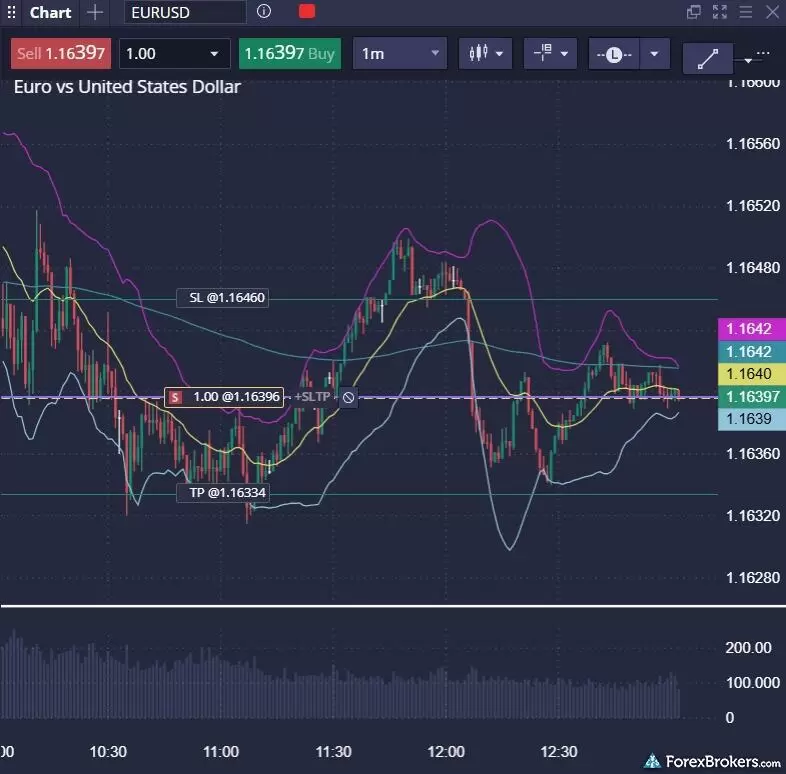
The broker's web platform, Tickmill Trader, supports drag-to-modify trading functionality on its charts.
Tools for advanced traders: Tickmill leans toward serious traders. Algo trading is supported through MetaTrader, FX Blue powers an Advanced Trading Toolkit of plugins, and the broker partners with BeeksFX for VPS hosting at a 20% discount. There is no public API, though Tickmill integrates with nine specialty providers such as MultiCharts, MotiveWave, and Sierra Chart. Backtesting and a manual trading journal are absent from Tickmill Trader, but its Trading Dashboard reports performance metrics like holding times and overall return.
Steven's take
Tickmill has done a nice job building out its copy trading offering, inching closer to the leaders in this category. While it bridges both MT4 and MT5, MT4 followers are essentially locked out if a provider starts trading CFD stocks, since those positions execute only on MT5.
Steven Hatzakis
Director of Online Broker Research
MetaTrader: The MetaTrader build is the standard release, branded with Tickmill's logo on the installer. MT5 carries the wider market range, including around 500 stock CFDs, while MT4 is more limited. Both run on the Classic and Raw accounts, and the FX Blue and Acuity plugins add a useful layer over the default experience.
Available trading platforms and features
Our platform walkthrough verified 97 charting indicators in Tickmill Trader, drag-to-modify order editing, and module linking between widgets, though the platform itself excludes algorithmic trading and backtesting.
| Feature |
Tickmill
|
|---|---|
| Desktop Platform (Windows) | Yes |
| Desktop Platform (Mac) | Yes |
| MetaTrader 4 (MT4) | Yes |
| MetaTrader 5 (MT5) | Yes |
| FX Blue | Yes |
| Proprietary Desktop Trading Platform | No |
| Proprietary Web Trading Platform | Yes |
| TradingView | Yes |
| cTrader | No |
| Algorithmic trading | Yes |
| API Access | No |
| Charts can be saved | Yes |
| Client sentiment data | No |
| Trading Signals | Yes |
| Price Alerts | No |
| Virtual Private Server (VPS) | Yes |
| Virtual Trading (Demo) | Yes |
| Charting - Indicators / Studies (Total) | 97 |
| Charting - Trade From Chart | Yes |
| Charting - TradingView | Yes |
Available order types
We verified market, limit, stop, OCO, and OTO orders within the trade ticket; trailing stops are available through the broker's MetaTrader platforms rather than Tickmill Trader.
| Feature |
Tickmill
|
|---|---|
| Order Type - Market | Yes |
| Order Type - Limit | Yes |
| Order Type - Stop | Yes |
| Order Type - Trailing Stop | Yes |
| Order Type - OCO | Yes |
| Order Type - OTO | Yes |
| Order Type - GSLO | No |
Research
Research at Tickmill is a story of strong tools paired with thin in-house content. The proprietary Tickmill Trader platform carries no news headlines, which puts it behind the MetaTrader and TradingView options, but the broker makes up ground with a solid set of third-party tools and calendars.
Calendars and data: The economic calendar, powered by Acuity, is one of the better ones I have used, with impact severity, forecast-versus-actual figures, country flags, and filtering. The same engine drives a corporate calendar covering earnings, dividends, stock splits, IPOs, and M&A, complete with earnings history and surprise data. Macro reports and financial statement data, however, are not available.
Market analysis: Tickmill's analysts publish daily commentary on the blog, and there is a weekly market video hosted by Patrick Munnelly. The Institutional Insights series, which draws on outlooks from banks like Goldman Sachs, adds a perspective I rarely see from a broker, though some articles rendered as raw markdown rather than clean text. The video analysis is competent but plain, and is mostly a screen-share with no presenter overlay.
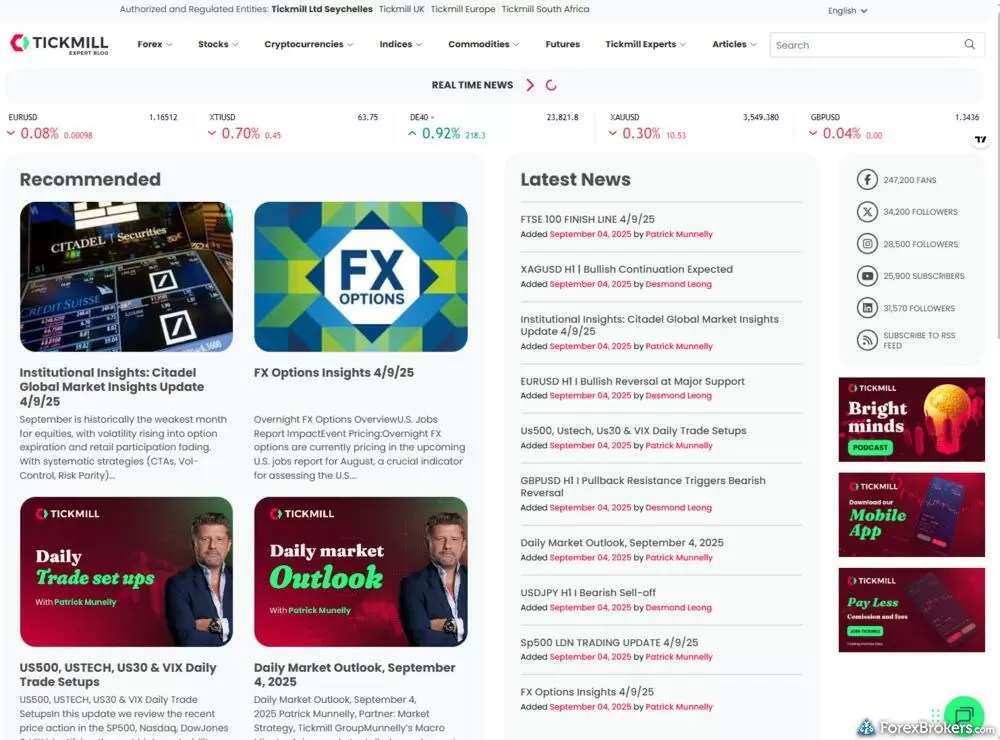
The "Expert Blog" section of the Tickmill website contains daily articles with expert analysis.
Signals and sentiment: Trading signals are a highlight. Tickmill includes the Signal Centre module from Acuity in its client portal. The underlying provider, PIA First, is an established, FCA-regulated signals firm. Sentiment data is available through TradingView's native platform and an Acuity widget, although Tickmill does not publish its own percentage of clients long or short an asset, which the best brokers often do.
What is missing: Autochartist, Trading Central, and TipRanks are all absent. Several content series have also gone quiet. Livestreams have not resumed in more than 10 months, and the Bright Minds and T-Show podcasts seem to be discontinued, with the more recent Trader's Clinic not updated in seven months.
Available research tools
Our analysis highlights Acuity-powered economic and corporate calendars and trading signals through the Signal Centre, though Autochartist, Trading Central, and top-tier news headlines are not available.
| Feature |
Tickmill
|
|---|---|
| Forex News (Top-Tier Sources) | No |
| Daily Market Commentary (Articles) | Yes |
| Daily Market Commentary (Videos) | No |
| Economic Calendar | Yes |
| Research - Earnings Calendar | Yes |
| Acuity Trading | Yes |
| Autochartist | No |
| TipRanks | No |
| Trading Central | No |
| Mobile Research - News | No |
| Mobile Research - Economic Calendar | No |
| Mobile Research - Market Movers | No |
Education
Tickmill's education has a solid foundation, but it is scattered across the broker's websites, and which pieces you can see may depend on your region.
Structured courses: The clearest highlight is a set of three courses run with the London Stock Exchange and Knightsbridge Trading Academy. There is a beginner introduction, an intermediate master trader program, and an advanced track, amounting to 28 hours in total with quizzes built in. They are CPD-accredited and free with an active live account, and I found them well-built. Beyond these, structured courses are thin, which leaves Tickmill behind peers that offer multi-asset curricula with progress tracking.
Videos and the Education Hub: The Education Hub centers on futures and options, with CME Group content organized into video playlists. Short explainer videos on the main website are basic and are closer to a quick cartoon overview than a deep dive. The YouTube channel is where the real depth sits with a large archive of quality videos going back more than a decade, spread across regional and language-specific channels.

Tickmill’s educational video series on YouTube, this one covering an introduction to futures trading.
In-platform guidance: Contextual education is light. There are no tooltips in the trade ticket, though clear error messages will nudge you to correct an invalid stop-loss or an oversized order, and every watchlist row carries a short description of the instrument. For example, you learn that the US30 tracks the Dow Jones Industrial Average by reading the symbol description.
Where it falls short: The biggest gap is written education. Tickmill's in-house analysts, including Patrick Munnelly, James Harte, and Desmond Leong, write extensively, but their work sits in market analysis rather than teaching material. Platform tutorials exist for MetaTrader and Tickmill Trader across iOS, Android, and web, yet they are short and scattered across the site rather than collected in one place. There is also no education section in the mobile app.
Available educational offerings
We found weekly webinars, a deep YouTube video archive, and three CPD-accredited courses produced with the London Stock Exchange; a structured, in-app learning path remains missing.
| Feature |
Tickmill
|
|---|---|
| Education (Forex) | Yes |
| Education (CFDs) | No |
| Education (Crypto) | No |
| Education (Stocks) | No |
| Education Area (Website) | Yes |
| Education Area (Mobile App) | No |
| Webinars | Yes |
| Videos - Beginner Trading Videos | Yes |
| Videos - Advanced Trading Videos | Yes |
Final thoughts
Tickmill makes the most sense for one kind of trader: the cost-focused, active forex and CFD trader who lives in MetaTrader. If that is you, the Raw account's low all-in pricing, the full MT4 and MT5 toolkit, FX Blue add-ons, and discounted VPS hosting add up to a strong package. For these reasons, Tickmill placed among our top brokers for MetaTrader and algorithmic trading in our 2026 Annual Awards.
What keeps it out of the top tier is reach. The range of investments is modest, with no real way to own stocks or ETFs. Additionally, research leans on third-party tools while its own content has thinned. Education, though improving, is scattered. If low costs and a serious algo setup are your priorities, Tickmill earns a close look. But if you want a broad multi-asset menu, polished research, or a structured learning path, I would compare its offering to our list of the best brokers before committing.
Tickmill's Star Ratings
| Feature |
Tickmill
|
|---|---|
| Overall Rating |
|
| Trust Score | 85 |
| Range of Investments |
|
| Trading Fees |
|
| Trading Platforms |
|
| Research |
|
| Mobile Trading |
|
| Education |
|
Our testing
Why you should trust us
Steven Hatzakis is a well-known finance writer, with 25+ years of experience in the foreign exchange and financial markets. He is the Global Director of Online Broker Research for Reink Media Group, leading research efforts for ForexBrokers.com since 2016. Steven is an expert writer and researcher who has published over 1,000 articles covering the foreign exchange markets and cryptocurrency industries. He has served as a registered commodity futures representative for domestic and internationally-regulated brokerages. Steven holds a Series III license in the US as a Commodity Trading Advisor (CTA).
All content on ForexBrokers.com is handwritten by a writer, fact-checked by a member of our research team, and edited and published by an editor. Our ratings, rankings, and opinions are entirely our own, and the result of our extensive research and decades of collective experience covering the forex industry.
Ultimately, our rigorous data validation process yields an error rate of less than .1% each year, providing site visitors with quality data they can trust. Click here to learn more about how we test.
How we tested
At ForexBrokers.com, our online broker reviews are based on our collected quantitative data as well as the observations and qualified opinions of our expert researchers. Each year we publish tens of thousands of words of research on the top forex brokers and monitor dozens of international regulator agencies (read more about how we calculate Trust Score here).
Mobile testing is conducted on modern devices that run the most up-to-date operating systems available:
- For Apple, we use MacBook Pro laptops running macOS 15.3, and the iPhone XS running iOS 18.3.
- For Android, we use the Samsung Galaxy S20 and Samsung Galaxy S23 Ultra devices running Android OS 15.
All websites and web-based platforms are tested using the latest version of the Google Chrome browser.
Our researchers thoroughly test a wide range of key features, such as the availability and quality of watch lists, mobile charting, real-time and streaming quotes, and educational resources – among other important variables. We also evaluate the overall design of the mobile experience, and look for a fluid user experience moving between mobile and desktop platforms.
Forex Risk Disclaimer
There is a very high degree of risk involved in trading securities. With respect to margin-based foreign exchange trading, off-exchange derivatives, and cryptocurrencies, there is considerable exposure to risk, including but not limited to, leverage, creditworthiness, limited regulatory protection and market volatility that may substantially affect the price, or liquidity of a currency or related instrument. It should not be assumed that the methods, techniques, or indicators presented in these products will be profitable, or that they will not result in losses. Read more on forex trading risks.
Read next
- Best Copy Trading Platforms for 2026
- Compare Forex Brokers
- Best Forex Trading Apps for 2026
- Best Low Spread Forex Brokers for 2026
- Best MetaTrader 4 (MT4) Brokers for 2026
- Best Forex Brokers for 2026
- Best Brokers for TradingView for 2026
- Best Forex Brokers for Beginners of 2026
- International Forex Brokers Search
More Forex Guides
- Best CFD Trading Platforms for 2026
- Best High-Leverage Forex Brokers for 2026
- Best Forex Signal Providers for 2026
- Best Forex Options Brokers for 2026
- Best PayPal Forex Brokers for 2026
- Best Forex Day Trading Platforms for 2026
- Best Algo Trading Software for 2026
- Best Market Maker Brokers in 2026
- Best High-Frequency Trading Software for 2026
- Best Forex Demo Accounts for 2026
- Best Brokers for TradingView for 2026
- Best Forex Brokers with APIs for 2026
- Best Brokers that Use TipRanks in 2026
- Best Trading Platforms for Mac Users of 2026
- Best Free Forex Trading Courses for 2026
- Best MetaTrader 4 (MT4) Brokers for 2026
- Best Crypto Brokers for 2026
- Best MetaTrader 5 (MT5) Forex Brokers for 2026
Popular Forex Broker Reviews
IG offers the ultimate comprehensive trading package, featuring excellent trading and research tools, and industry-leading education.
Steven Hatzakis May 21, 2026
Is Capital.com worth it in 2026? Our expert review covers 400+ crypto CFDs, a 0.64-pip EUR/USD spread, commission-free pricing, and platform quality.
Steven Hatzakis May 07, 2026
FxPro competes among the top MetaTrader brokers, featuring multiple account options and various execution methods.
Steven Hatzakis May 15, 2026
Eightcap review 2026: low-cost forex and CFD trading on TradingView, MetaTrader, and TradeLocker, with a deep crypto CFD lineup. Read our expert verdict.
Steven Hatzakis June 04, 2026
As a trusted multi-asset broker, XTB offers outstanding customer service, a wide variety of forex and CFDs, and an excellent overall trading experience.
Steven Hatzakis May 04, 2026
Plus500 is a trusted global brand that offers an easy-to-use trading platform for online traders, alongside access to share trading and selection of CFDs.
Steven Hatzakis May 04, 2026
Our 2026 HFM (HF Markets) review covers MT4, MT5, copy trading, the 344-symbol product offering, and 1.8-pip EUR/USD spreads, based on hands-on testing.
Steven Hatzakis May 29, 2026
Best known for its mobile trading app, Trading 212 offers an easy-to-use trading platform suite for CFD and share trading.
Steven Hatzakis May 14, 2026
Saxo is an exclusive multi-asset broker with brilliant research and a superb trading platform experience – and a selection of over 40,000 s securities.
Steven Hatzakis May 04, 2026
Interactive Brokers is a highly trusted multi-asset broker with an extensive offering of tradeable global markets.
Steven Hatzakis May 04, 2026
CMC Markets is well-trusted across the globe, and delivers a terrific trading experience thanks to its excellent pricing and nearly 12,000 tradeable instruments
Steven Hatzakis May 15, 2026
ACY Securities is a MetaTrader-only broker with a reasonable range of markets and a balanced account offering.
Steven Hatzakis May 04, 2026
IC Markets’ competitive pricing and scalable execution make it an excellent option for algorithmic traders.
Steven Hatzakis May 04, 2026
A trusted global brand, OANDA stands out for its reputation and quality market research.
Steven Hatzakis May 04, 2026
In my 2026 Exness review, I tested the Exness Terminal, MT4, and MT5 across 78 forex pairs. See my verdict on costs, research, and product range.
Steven Hatzakis May 27, 2026
Pepperstone offers a growing range of tradeable markets, good-quality research, and support for multiple social copy trading platforms.
Steven Hatzakis May 14, 2026
FP Markets shines as a low-cost broker for trading forex and CFDs – as long as you use the MetaTrader platform.
Steven Hatzakis May 04, 2026
Traders choose Admiral Markets (Admirals) for its excellent investor education and advanced MetaTrader features.
Steven Hatzakis May 04, 2026
Octa offers a basic, low-cost MetaTrader platform experience alongside its social copy-trading platform.
Steven Hatzakis May 04, 2026
Traders choose Swissquote for its quality research and vast multi-asset offering.
Steven Hatzakis May 04, 2026
eToro is a winner for its easy-to-use copy-trading platform, where traders can copy the trades of experienced investors – or receive exclusive perks for sharing.
Steven Hatzakis May 14, 2026
Check out our review of Charles Schwab, a highly trusted, multi-asset broker catering to U.S.-based and international forex traders.
Steven Hatzakis May 04, 2026
AvaTrade is a trusted global brand best known for offering an extensive selection of trading platforms for forex and CFD traders.
Steven Hatzakis May 04, 2026
For traders who appreciate advanced trading tools and quality market research, FXCM is a winner, especially for algorithmic trading.
Steven Hatzakis May 04, 2026
Backed by StoneX Group, City Index is a trusted brand known for its versatile trading platforms, excellent mobile app, and diverse market research.
Steven Hatzakis May 15, 2026
FOREX.com is a trusted brand that delivers an excellent trading experience for forex and CFDs traders across the globe.
Steven Hatzakis May 04, 2026About Tickmill
Tickmill was founded in 2014 by brothers Ingmar and Illimar Mattus, both longtime entrepreneurs in the forex industry. Today the Tickmill brand operates through several regulated entities, holding licenses with Tier-1 regulators in the United Kingdom (FCA) and Cyprus (CySEC), Tier-2 regulators in South Africa (FSCA) and the United Arab Emirates, and a Tier-4 regulator in Seychelles (FSA). According to the company, Tickmill Group has more than 250 staff and over 327,000 clients worldwide.
About the Editorial Team
Steven Hatzakis is the Global Director of Online Broker Research for ForexBrokers.com. Steven previously served as an Editor for Finance Magnates, where he authored over 1,000 published articles about the online finance industry. A forex industry expert and an active fintech and crypto researcher, Steven advises blockchain companies at the board level and holds a Series III license in the U.S. as a Commodity Trading Advisor (CTA).
Jeff Anberg is a Senior Editor at ForexBrokers.com. Along with years of experience in media distribution at a global newsroom, Jeff has a versatile knowledge base encompassing the technology and financial markets. He is a long-time active investor and engages in research on emerging markets like cryptocurrency. Jeff holds a Bachelor’s Degree in English Literature with a minor in Philosophy from San Francisco State University.
Blain Reinkensmeyer has 20 years of trading experience with over 2,500 trades placed during that time. He heads research for all U.S.-based brokerages on StockBrokers.com and is respected by executives as the leading expert covering the online broker industry. Blain’s insights have been featured in the New York Times, Wall Street Journal, Forbes, and the Chicago Tribune, among other media outlets.