 IG
IG FOREX.com
 CMC Markets
 XTB
XTB eToro
eToro AvaTrade
 Pepperstone
 FP Markets
 Tickmill
Best Switzerland Forex Brokers of 2026
Written by Steven Hatzakis
Director of Online Broker Research

Edited by John Bringans
Managing Editor

Fact-checked by Joey Shadeck
Research Analyst
Steven HatzakisDirector of Online Broker Research
Steven Hatzakis is the Global Director of Online Broker Research for ForexBrokers.com. He is a forex industry expert and an active fintech and crypto researcher.


 Why you can trust us
Led by Steven Hatzakis, Global Director of Online Broker Research, the ForexBrokers.com research team collects and audits data across more than 100 variables. We analyze key tools and features important to forex and CFD traders and collect data on commissions, spreads, and fees across the industry to help you find the best broker for your needs.
We also review each broker’s regulatory status; this research helps us determine whether you should trust the broker to keep your money safe. As part of this effort, we track 100+ international regulatory agencies to power our proprietary Trust Score rating system.
Our researchers open personal brokerage accounts and test all available platforms on desktop, web, and mobile for each broker reviewed on ForexBrokers.com. Learn more about how we test.
Switzerland is one of the most respected financial centers in the world, with a banking heritage that dates back centuries and some of the strictest regulatory standards anywhere in Europe. The Swiss Financial Market Supervisory Authority (FINMA) requires all locally operating forex and CFD brokers to be authorized as banks or securities dealers, which sets a higher bar than most jurisdictions and gives Swiss traders an unusually well-protected environment.
After more than two decades reviewing brokers across dozens of jurisdictions, I've found Switzerland to be one of the most distinct regulatory environments worth understanding. Every broker in this guide has been independently evaluated by the ForexBrokers.com research team, with extra weight given to FINMA licensing, financial strength, and the specific protections Swiss residents should expect when trading with locally regulated firms.
Best Swiss Forex Brokers
To find the best forex brokers in Switzerland, we created a list of all FINMA authorised brokers, then ranked brokers by their Overall ranking.
Here is our list of the top Swiss forex brokers:
| Company | Accepts CH Residents | Regulated by FINMA | Average spread (EUR/USD) - Standard account | Minimum Deposit | Overall Rating |
 IG IG
|
0.91 | £1 |
|
||
 Interactive Brokers Interactive Brokers
|
0.226 | $0 |
|
||
 Saxo Saxo
|
1.0 | $0 |
|
||
 FOREX.com FOREX.com
|
1.00 | $100 |
|
||
 XTB XTB
|
0.92 | $0 |
|
||
 Capital.com Capital.com
|
0.7 | $20 |
|
||
 Plus500 Plus500
|
1.3 | €50 |
|
||
 AvaTrade AvaTrade
|
0.93 | $100 |
|
||
 XM Group XM Group
|
2 | $5 |
|
||
 Pepperstone Pepperstone
|
1.1 | $10 |
|
||
 FP Markets FP Markets
|
1.3 | $100 AUD |
|
||
 FxPro FxPro
|
1.6 | $100 |
|
||
 IC Markets IC Markets
|
0.62 | $200 |
|
||
 BlackBull Markets BlackBull Markets
|
1.16 | $0 |
|
||
 Tickmill Tickmill
|
1.70 | $100 |
|
||
 Trading 212 Trading 212
|
2.7 | €1 |
|
||
 HYCM (Henyep Capital Markets) HYCM (Henyep Capital Markets)
|
1.3 | $20 |
|
||
 HFM HFM
|
1.8 | $0 |
|
||
 ActivTrades ActivTrades
|
1.08 | $0 |
|
||
 Questrade Questrade
|
0.8 or higher | $0 |
|
||
 Eightcap Eightcap
|
1.0 | $100 |
|
||
 Spreadex Spreadex
|
0.81 | $0 |
|
CFDs are complex instruments and come with a high risk of losing money rapidly due to leverage. Between 51% and 89% of retail investor accounts lose money when trading CFDs. You should consider whether you understand how CFDs work and whether you can afford to take the high risk of losing your money.
Swiss Financial Market Supervisory Authority (FINMA)
- FINMA is a Trusted, Tier-1 regulatory jurisdiction. Learn more about international forex regulation and why it's important.
- The Swiss Financial Market Supervisory Authority regulates Switzerland's banks, insurance companies, securities dealers, and asset managers under the Financial Market Supervision Act (FINMASA).
- FINMA requires all locally operating forex and CFD brokers to be authorized as banks or securities dealers, which sets a higher bar than most jurisdictions. Swiss traders also have access to internationally regulated brokers operating from offshore.
- Locally licensed FINMA banks participate in esisuisse, Switzerland's depositor protection scheme, which covers client cash deposits up to CHF 100,000 in the event of broker insolvency. Securities held in segregated accounts are not affected by broker insolvency, as they remain the property of the client.
- Always confirm a broker's licence on FINMA's public register of authorized institutions.
Winners Summary
1. IG - Best forex broker in Switzerland
| Company | Accepts CH Residents | Regulated by FINMA | Overall Rating | Average spread (EUR/USD) - Standard account | Minimum Deposit |
|
IG
|
|
0.91 | £1 |
What stands out: IG is my top pick for forex traders in Switzerland in 2026. Swiss residents trade through IG Bank S.A., which is incorporated in Geneva and authorized as a bank and securities dealer by FINMA. Very few CFD providers hold a Swiss banking license, and IG Bank gives Swiss traders many of the perks you'd expect from a Swiss bank account alongside the platform depth and market access IG is known for globally.
Trust and regulation: As a FINMA-licensed bank, IG Bank S.A. is held to a higher standard than typical CFD brokers, including bank-grade capital adequacy, deposit protection up to CHF 100,000 under the Swiss esisuisse scheme, and stringent client fund segregation rules. Globally, IG Group holds 11 Tier-1 regulatory licenses and remains publicly traded on the London Stock Exchange (LSE: IGG).
Platforms: Swiss traders get access to IG's proprietary web and mobile platforms, MetaTrader 4, and ProRealTime. The IG Trading app earned our 2026 Annual Award for #1 Mobile App, with charting, customizable layouts, and integrated Reuters news. IG Switzerland is also a strong choice for traders who want exposure to the full range of IG's 19,000+ tradeable markets.
Steven's take:
"Switzerland's regulatory environment is one of the strictest in the world, and IG Bank stands out as one of the few CFD providers operating as a fully licensed Swiss bank."
Steven Hatzakis
Director of Online Broker Research
Pricing: EUR/USD spreads start from around 0.6 pips, with CHF-denominated funding available through local Swiss banking channels. The IG Bank setup also makes it easy for Swiss traders to consolidate trading and banking under one regulated institution.

The IG Trading mobile app charting supports trading from the chart, as well as news overlays and multiple concurrent indicators.
2. Interactive Brokers - Best for professional traders
| Company | Accepts CH Residents | Regulated by FINMA | Overall Rating | Minimum Deposit | Average spread (EUR/USD) - Standard account |
|
Interactive Brokers
|
|
$0 | 0.226 |
What stands out: Interactive Brokers (IBKR) is a strong fit for Swiss traders who prioritize multi-asset reach and low-cost execution over a local Swiss banking license. Founded in 1977 and publicly traded on NASDAQ (IBKR), IBKR serves Swiss clients through Interactive Brokers (U.K.) Limited, which is regulated by the U.K.'s Financial Conduct Authority. That makes IBKR a U.K.-regulated broker for Swiss residents rather than a FINMA-licensed entity, which is an important distinction worth understanding.
Trust and regulation: Swiss residents who open accounts with IBKR are clients of IB U.K. (FCA-regulated), with securities held at IBKR LLC in the U.S. under SEC and FINRA oversight. That means SIPC protection up to $500,000 (with $250,000 of cash protection) rather than Swiss esisuisse deposit coverage. For some Swiss traders, that's a meaningful trade-off; for others, IBKR's institutional capital base and Tier-1 oversight provide enough comfort to outweigh the lack of FINMA supervision.
Platforms: Trader Workstation (TWS) is the centerpiece, with programmable order types, complex algos, advanced charting, and access to over 150 global markets including the SIX Swiss Exchange. IBKR Mobile and IBKR Desktop offer cleaner interfaces for traders who don't need TWS's full depth. Swiss traders also get access to multi-currency funding, which is particularly useful for managing CHF, EUR, and USD positions in a single account.

The watchlist on the IBKR mobile app, showing the quick view chart for the selected EUR/USD forex pair.
Pricing: EUR/USD spreads sit around 0.2 pips plus a low commission, with tiered pricing rewarding active traders. There's no minimum deposit, though the per-trade minimum commission can hit smaller positions disproportionately, so IBKR tends to be most cost-effective for traders working at standard lot sizes or above.
3. Saxo - Best for forex research
| Company | Accepts CH Residents | Regulated by FINMA | Overall Rating | Minimum Deposit | Average spread (EUR/USD) - Standard account |
|
Saxo
|
|
$0 | 1.0 |
What stands out: Saxo is one of the strongest options for Swiss traders who want a local FINMA-licensed bank paired with one of the deepest multi-asset platforms in the industry. Swiss clients are served directly through Saxo Bank (Switzerland) Ltd., which is incorporated in Switzerland and licensed as a bank and securities dealer by FINMA. That puts Saxo in rare company, very few CFD providers hold a Swiss banking license, and the local entity status gives Swiss traders direct esisuisse deposit protection.
Trust and regulation: As a FINMA-licensed Swiss bank, Saxo Bank (Switzerland) Ltd. is held to banking-grade capital and liquidity standards, with Swiss esisuisse coverage protecting client cash up to CHF 100,000. Securities are held in segregated accounts under your name, which means they remain your property in the event of broker insolvency. Saxo Bank A/S, the Danish parent, is also classified as a Systemically Important Financial Institution (SIFI) and rated A- by S&P.
Platforms: Saxo's proprietary SaxoTraderGO web platform and SaxoTraderPRO desktop platform earned our 2026 Annual Award for #1 Platforms & Tools. SaxoTraderGO is approachable for everyday traders, while SaxoTraderPRO delivers depth-of-market data, algorithmic order types, and advanced charting for active traders. Both platforms sync seamlessly across devices, and TradingView is also integrated for charting-focused users.
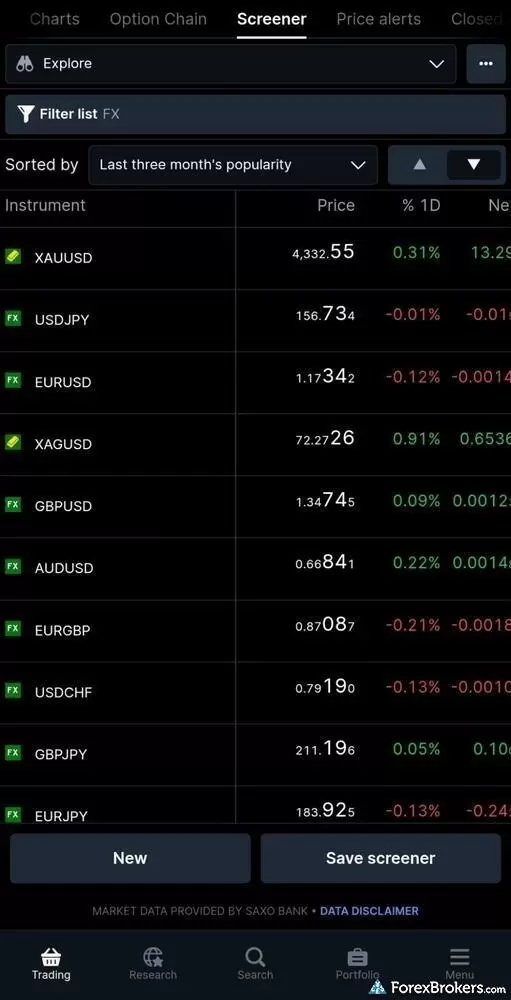
The SaxoTraderGO mobile app showcases a powerful, highly customizable screener tool within the main Trading tab. Here, a custom filter for forex and precious metals is applied and sorted by the "Last three month's popularity," offering traders a clean, real-time overview of live pricing and daily percentage changes for heavily traded assets like Gold (XAU/USD), USD/JPY, and EUR/USD.
Pricing: Swiss traders also benefit from Saxo's tight currency conversion fees (0.25%, among the lowest of any Swiss broker), with spreads on EUR/USD starting around 0.6 pips on the Classic account. CHF-denominated funding is supported, and Saxo's product lineup spans more than 70,000 instruments across forex, equities, ETFs, options, futures, and bonds.
Trading platforms for Switzerland forex traders
| Company | Accepts CH Residents | Regulated by FINMA | MetaTrader 4 (MT4) | MetaTrader 5 (MT5) | TradingView |
|
IG
|
Yes | Yes | Yes | ||
|
Interactive Brokers
|
No | No | Yes | ||
|
Saxo
|
No | No | Yes |
Our testing
Why you should trust us
Steven Hatzakis is a well-known finance writer, with 25+ years of experience in the foreign exchange and financial markets. He is the Global Director of Online Broker Research for Reink Media Group, leading research efforts for ForexBrokers.com since 2016. Steven is an expert writer and researcher who has published over 1,000 articles covering the foreign exchange markets and cryptocurrency industries. He has served as a registered commodity futures representative for domestic and internationally-regulated brokerages. Steven holds a Series III license in the US as a Commodity Trading Advisor (CTA).
All content on ForexBrokers.com is handwritten by a writer, fact-checked by a member of our research team, and edited and published by an editor. Our ratings, rankings, and opinions are entirely our own, and the result of our extensive research and decades of collective experience covering the forex industry.
Ultimately, our rigorous data validation process yields an error rate of less than .1% each year, providing site visitors with quality data they can trust. Click here to learn more about how we test.
More about Switzerland's forex markets and regulation
Switzerland operates one of the strictest financial regulatory environments in the world, led by the Swiss Financial Market Supervisory Authority (FINMA). FINMA regulates Switzerland's banks, insurance companies, securities dealers, and asset managers under the Financial Market Supervision Act (FINMASA), and uniquely among most jurisdictions, it requires forex and CFD brokers to be authorized as banks or securities dealers rather than as standalone CFD providers. That sets a higher bar than most regulators and gives Swiss traders some of the strongest local protections available. Swiss traders can verify authorized institutions on FINMA's public register.
The Swiss National Bank (SNB), Switzerland's central bank, oversees monetary policy and the issuance of the Swiss franc (CHF). The SNB famously removed the EUR/CHF currency peg in January 2015, an event that reshaped global forex markets and reinforced the SNB's reputation for independent decision-making. While the SNB handles monetary policy and currency stability, FINMA remains the primary regulator for forex and CFD brokers operating in Switzerland. Locally licensed FINMA banks participate in esisuisse, Switzerland's depositor protection scheme, which covers client cash deposits up to CHF 100,000 per client.
Because Switzerland sits outside the EU but maintains some of the most rigorous local regulatory standards in the world, Swiss traders have access to genuinely bank-grade protections when trading with FINMA-licensed firms. Choosing a FINMA-regulated broker is the most direct way for Swiss residents to ensure their funds are protected under Switzerland's strict financial supervision rules. Our research team independently verifies every broker's regulatory licenses to ensure Swiss traders have accurate, reliable information about the brokers they use. Learn more about Trust Score and the 100+ regulatory agencies tracked by the ForexBrokers.com research team.
How we tested
At ForexBrokers.com, our online broker reviews are based on our collected quantitative data as well as the observations and qualified opinions of our expert researchers. Each year we publish tens of thousands of words of research on the top forex brokers and monitor dozens of international regulator agencies (read more about how we calculate Trust Score here).
Mobile testing is conducted on modern devices that run the most up-to-date operating systems available:
- For Apple, we use MacBook Pro laptops running macOS 15.3, and the iPhone XS running iOS 18.3.
- For Android, we use the Samsung Galaxy S20 and Samsung Galaxy S23 Ultra devices running Android OS 15.
All websites and web-based platforms are tested using the latest version of the Google Chrome browser.
Our researchers thoroughly test a wide range of key features, such as the availability and quality of watch lists, mobile charting, real-time and streaming quotes, and educational resources – among other important variables. We also evaluate the overall design of the mobile experience, and look for a fluid user experience moving between mobile and desktop platforms.
Compare Switzerland Brokers
Popular Forex Guides
- Best Forex Brokers for 2026
- International Forex Brokers Search
- Best MetaTrader 4 (MT4) Brokers for 2026
- Best Forex Trading Apps for 2026
- Best Brokers for TradingView for 2026
- Best Forex Brokers for Beginners of 2026
- Compare Forex Brokers
- Best Low Spread Forex Brokers for 2026
- Best Copy Trading Platforms for 2026
More Forex Guides
- Best Brokers that Use TipRanks in 2026
- Best Brokers for TradingView for 2026
- Best Algo Trading Software for 2026
- Best High-Frequency Trading Software for 2026
- Best Forex Day Trading Platforms for 2026
- Best MetaTrader 4 (MT4) Brokers for 2026
- Best Crypto Brokers for 2026
- Best Trading Platforms for Mac Users of 2026
- Best PayPal Forex Brokers for 2026
- Best Free Forex Trading Courses for 2026
- Best Market Maker Brokers in 2026
- Best Forex Brokers with APIs for 2026
- Best Forex Signal Providers for 2026
- Best CFD Trading Platforms for 2026
- Best Forex Options Brokers for 2026
- Best High-Leverage Forex Brokers for 2026
- Best MetaTrader 5 (MT5) Forex Brokers for 2026
- Best Forex Demo Accounts for 2026
Forex Risk Disclaimer
There is a very high degree of risk involved in trading securities. With respect to margin-based foreign exchange trading, off-exchange derivatives, and cryptocurrencies, there is considerable exposure to risk, including but not limited to, leverage, creditworthiness, limited regulatory protection and market volatility that may substantially affect the price, or liquidity of a currency or related instrument. It should not be assumed that the methods, techniques, or indicators presented in these products will be profitable, or that they will not result in losses. Read more on forex trading risks.
About the Editorial Team
Steven Hatzakis is the Global Director of Online Broker Research for ForexBrokers.com. Steven previously served as an Editor for Finance Magnates, where he authored over 1,000 published articles about the online finance industry. A forex industry expert and an active fintech and crypto researcher, Steven advises blockchain companies at the board level and holds a Series III license in the U.S. as a Commodity Trading Advisor (CTA).
John Bringans is the Managing Editor at ForexBrokers.com. An experienced media professional, John has a decade of editorial experience with a background that includes key leadership roles at global newsroom outlets. He holds a Bachelor’s Degree in English Literature from San Francisco State University, and conducts research on forex and the financial services industry while assisting in the production of content.
Joey Shadeck is a Content Strategist and Research Analyst for ForexBrokers.com. He holds dual degrees in Finance and Marketing from Oakland University, and has been an active trader and investor for close to ten years. An industry veteran, Joey obtains and verifies data, conducts research, and analyzes and validates our content.